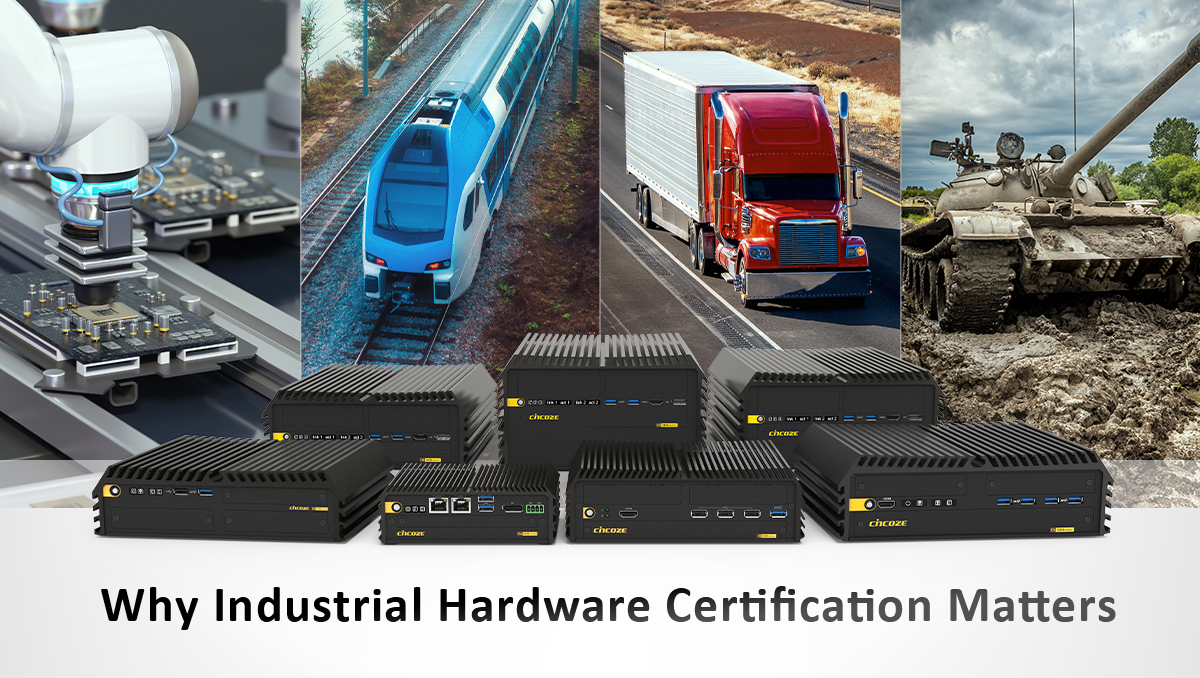
Why Industrial Hardware Certification Matters
How do you know an industrial computer will run as well as it says it will? In smart manufacturing, automotive, and rail transportation applications, industrial computers often have to run for long periods while contending with environmental challenges such as extreme temperatures, continuous vibration, electromagnetic interference, and unstable power. The real question is whether the manufacturer’s claims hold up in real-world conditions: can the computer withstand harsh environments and keep running reliably over the long term?
Product specifications and hardware design alone are not enough to predict equipment reliability. Without recognized product-quality standards, unexpected equipment failure, regulatory non-compliance, or additional validation can delay projects and increase costs. That is why international certification and standardized testing are crucial: they verify hardware performance and safety under specific conditions and help system integrators (SIs) and equipment manufacturers confirm whether a product fully meets target-market and application requirements.
The Four Key Benefits of Industrial Hardware Certification
Industrial hardware certification is a key basis for assessing equipment reliability and compliance, delivering four main benefits.
Ensure Stable Equipment Operation
Environmental and reliability testing verifies the hardware's ability to withstand high and low temperatures, vibration, and electromagnetic interference, reducing the risk of equipment failure and unexpected downtime.
Improve Equipment and Operational Safety
Applicable electrical safety standards and protection requirements reduce the risk of electric shock, overheating, and other electrical hazards, helping to keep equipment and operators safe.
Meet Market and Regulatory Requirements
Complying with regulations across different countries, industries, and customers lowers market-entry barriers and avoids project delays or extra costs caused by regulatory non-compliance.
Simplify System Integration and Deployment
Choosing industrial computers with the relevant test and compliance documentation provides a clear technical basis, reducing the integration and validation burden and lowering project development risk.
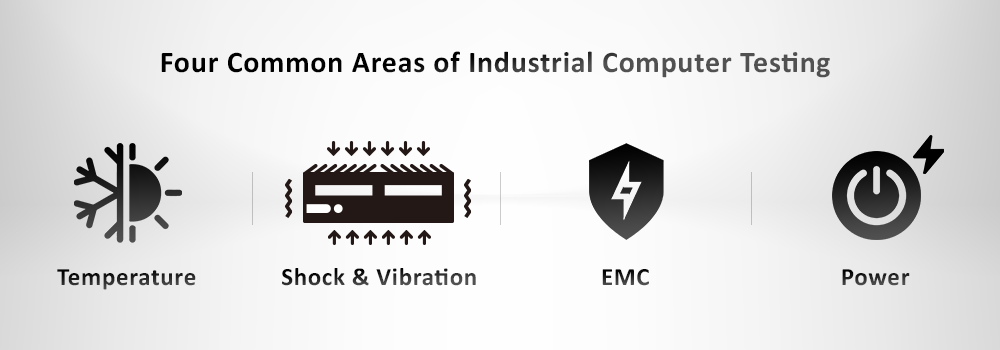
Four Common Areas of Industrial Computer Testing
Temperature Testing
Industrial computers may be deployed in environments with extremely high and low temperatures and rapid temperature changes. High temperatures can cause electronic components to overheat or lose performance, low temperatures can affect equipment startup, and repeated temperature changes can create thermal stress that affects hardware reliability.
The most commonly used environmental tests under IEC 60068 include IEC 60068-2-1 (low temperature), IEC 60068-2-2 (dry heat), and IEC 60068-2-14 (temperature change), which evaluate equipment's ability to withstand specified temperature conditions. In addition, Method 501.7 and 502.7 of MIL-STD-810H provide test methods for high- and low-temperature environments, respectively.
Vibration and Shock Testing
Factory machinery, mobile equipment, and moving vehicles can generate continuous vibration and sudden shocks that loosen connectors, damage electronic components, or cause equipment to malfunction.
IEC 60068-2-6 and IEC 60068-2-27 cover sinusoidal vibration and mechanical shock testing, respectively, while IEC 61373 applies to vibration and shock testing of railway onboard equipment. MIL-STD-810H Methods 514.8 and 516.8 also provide relevant test methods to help verify the hardware’s ability to withstand mechanical stress.
EMC — Electromagnetic Compatibility Testing
Electromagnetic compatibility (EMC) has two main aspects: electromagnetic emission and electromagnetic immunity, which evaluate the interference a device generates and its ability to resist external interference, respectively.
The common IEC/EN 61000-6-2 and 61000-6-4 standards set out immunity and electromagnetic emission requirements for industrial environments, respectively, and include or reference various test items, such as electrostatic discharge (ESD), electrical fast transient (EFT), and surge immunity tests. In addition, EN 50121-3-2 for rail transportation and MIL-STD-461 for military applications set electromagnetic compatibility requirements for their specific industries.
Power — Power Adaptability Testing
Industrial computers can face voltage fluctuations, brief power interruptions, and other power anomalies that affect normal equipment operation. Power adaptability testing evaluates the ability of hardware to withstand different power conditions, reducing the risk of failures caused by unstable power.
Different industries set their own power requirements. For example, EN 50155 covers the power supply conditions of railway onboard electronic equipment, MIL-STD-1275 specifies the power characteristics of military ground vehicles, and MIL-STD-704 sets power requirements for aircraft electrical systems.
How to Choose an Industrial Computer with the Right Certifications
With such a wide range of certifications and testing standards, the key is to choose an industrial computer that meets the requirements of the actual deployment environment and market, rather than simply seeking more certifications.
Assess the Deployment Environment
Confirm the temperature range, vibration intensity, electromagnetic interference, and power conditions the equipment will face. For example, factory equipment should prioritize EMC protection, while automotive and rail applications must account for continuous vibration and power variations.
Confirm Market and Regulatory Requirements
Check the applicable regulations and compliance requirements for the regions where the product will be sold, such as CE in the EU, UKCA in the UK, and FCC in the US.
Confirm Industry Certification Requirements
System integrators (SIs) and machine builder should choose industrial computers that meet the relevant certifications and testing standards for the industry in which the final equipment will be used. For example, rail transportation often involves EN 50121-3-2, while automotive applications may require compliance with regulations such as E-mark.
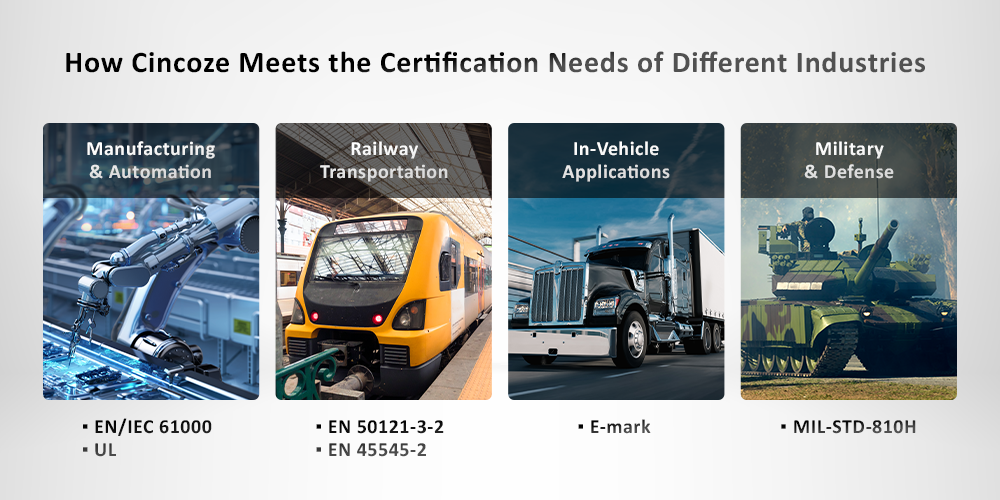
How Cincoze Meets the Certification Needs of Different Industries
To address the environmental and regulatory requirements of different industries, Cincoze offers industrial computers tested and certified to international standards, helping customers meet diverse application needs.
Manufacturing & Automation
Electromagnetic compatibility and electrical safety are priorities on smart manufacturing sites. Cincoze product lines such as its industrial panel PCs (CV+P Series) and DIN-rail computers (MD Series) comply with EN/IEC 61000 series EMC standards and carry UL safety certification. The newly launched external Power Protection Module (PPM) can be paired with designated industrial computers to suppress EFT interference at the power input, helping them meet the testing requirements of EN/IEC 61000-6-2 and providing a more flexible protection upgrade.
Railway Transportation
Rail equipment must cope with continuous vibration, temperature changes, and electromagnetic interference. The high-performance compact embedded computers (DX Series) and MXM GPU computers (GM Series) offer product options that meet the EN 50121-3-2 rail EMC standard and EN 45545-2 fire protection requirements, supporting railway and onboard equipment applications.
In-Vehicle Applications
In-vehicle equipment must withstand vibration on the move and power fluctuations during engine starts, and have electromagnetic compatibility. The high-performance, basic I/O embedded computers (DV Series), mid-performance, power-saving embedded computers (DI Series), and dual full-length GPU expandable computers (GP Series) offer product options with E-mark automotive EMC certification to meet the needs of in-vehicle computing applications.
Military & Defense
Military equipment often faces extreme temperatures, vibration, and shock. Models from the high-performance PCIe-expandable embedded computers (DS Series) and the GPU embedded computer product line (GP and GM Series) have passed MIL-STD-810H vibration and shock testing and combine this with a rugged design to deliver reliable computing in harsh environments.
Q&A
Q1:Do industrial computers need to be certified?
A: Yes. Industrial computers are often deployed in environments with extreme temperatures, continuous vibration, electromagnetic interference, and unstable power. International standard testing and the relevant certifications verify the resilience and safety of hardware under specific conditions, reducing the risk of equipment failure, unexpected downtime, and project deployment problems and ensuring stable long-term operation.
Q2:Which areas of testing should be considered when evaluating the reliability of an industrial computer?
A: There are four main areas: (1) temperature testing, which checks the ability of equipment to withstand high and low temperatures and temperature changes; (2) vibration and shock testing, which verifies the ability of hardware to withstand mechanical stress; (3) electromagnetic compatibility (EMC) testing, which evaluates electromagnetic emissions and immunity; and (4) power adaptability testing, which confirms how equipment performs during voltage fluctuations and power anomalies.
Q3:Can industrial computer certification reduce development costs for equipment manufacturers?
A: Yes. Choosing industrial computers that have already passed the relevant tests and certifications provides existing test reports and compliance documents for integration reference, reducing some validation work and lowering the risk of redesigning or replacing hardware due to non-compliance. This helps control development costs and project timelines.